


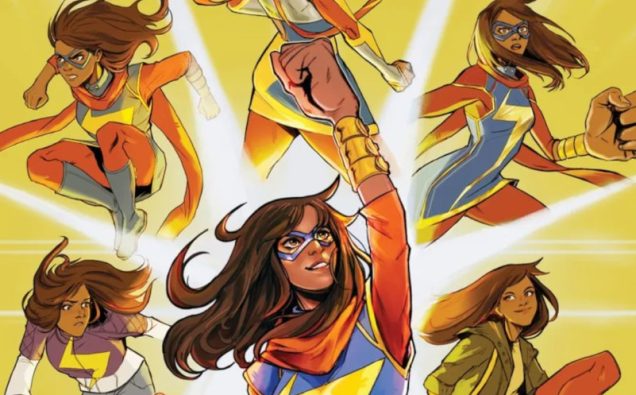
It has been all but directly confirmed that “The Mutant Saga” is coming to the Marvel Cinematic Universe. Since Disney purchased Fox in 2019 and gained the movie and TV rights to the X-Men, fans have wondered when mutants will appear in the MCU. With many assuming that we will start seeing mutants and the X-Men in the MCU within a few years, debate has already begun about which characters will appear and who should play them. Oddly missing from these conversations is what role Ms. Marvel (Kamala Khan) will have.
Diving into the character’s history something becomes obvious: Kamala Khan has failed to become a marquee character. Despite the effort Marvel has put into making Khan popular, she is nowhere near the popularity of Miles Morales’ Spider-Man. From lackluster sales to multimedia appearances (the streaming show, Ms. Marvel; the movie, The Marvels; and the video game, Marvel’s Avengers) that have all been commercial failures, Ms. Marvel is Fetch—and Marvel needs to stop trying to make her happen.
I know this is a hot take on a character that so many Marvel fans want to be popular, but come along as I show that Kamala Khan’s Ms. Marvel is a failed experiment.
After issue 1, her sales dropped
Kamala Khan’s first series started with when Marvel launched Ms. Marvel #1 in March 2006. This issue sold an estimated 73,398 copies; a number that is respectable, but already well below contemporary franchise leaders. However, by Ms. Marvel #12 (February 2007), orders had plummeted to 30,758 copies, a drop of almost 60 percent in one year. The rapid slide signaled to retailers that demand was soft, shrinking shelf space just as Marvel was trying to position the name “Ms. Marvel” for bigger things.
Worse yet, the pattern continued. For example, in March 2019 Marvel started another Ms. Marvel series with Magnificent Ms. Marvel #1. It only sold 27,706 copies. That low number only became more concerning because one year later, Magnificent Ms. Marvel #12 (February 2020) only sold 12,823 copies. (For context, the best-selling comic book in March 2019 was Detective Comics #1000, which sold 526,941 copies, and the best-selling comic book of February 2020 was Wolverine #1, which sold 190,568 copies.)
While those are only four data points, they do correctly represent consistent trajectory that Ms. Marvel’s sales have been on: which is downward.
Stop-Start Publishing Initiatives
Willow Wilson is Kamal Khan’s creator, and while Khan’s first series did suffer from declining sales, it was still critically acclaimed and benefited from Wilson having a unique view of the character. Unfortunately, the following writers struggled to tell stories about Khan that audiences wanted to buy. As a result, the following series centering on Khan/Ms. Marvel were cancelled or truncated within a year. These inconsistencies killed word-of-mouth momentum just as other teen heroes—especially Miles Morales—were enjoying uninterrupted monthly exposure. As a result, retailers and buyers came to see Kamala launches as temporary events rather than long-term fixtures, shrinking initial orders even further.
Even Marvel’s latest attempt to make Ms. Marvel relevant by making her both Inhuman and mutant has failed to garner widespread acceptance by fans. While this change allowed the comic book version of the character to align with the version in the Disney+ series and benefit from the popularity of the X-Men, it ultimately failed. Instead of clarifying her identity, it reinforced the sense that Marvel keeps rewriting her fundamentals in search of a hook.
Cross-Media Misfires (and the Numbers to Prove It)
A decade of stop-start initiatives left Kamala Khan leaning on three “first impression” vehicles—a streaming debut, a AAA video-game lead, and a feature-film showcase—to break into mainstream awareness. All three under-performed. Ms. Marvel opened on Disney+ to just 775,000 U.S. households in its first five days, the lowest launch of any MCU series measured by Samba TV. Three years later The Marvels reached theaters and finished with $206 million worldwide on a production budget north of $270 million, becoming the franchise’s first outright box-office bomb. For comparison, Sony’s Spider-Man: Across the Spider-Verse—fronted by fellow teen hero Miles Morales—cleared $691 million on roughly half the spend, underscoring how far Kamala’s marquee outing fell behind competing IP.
The financial picture is just as bleak in interactive media. Square Enix’s live-service title Marvel’s Avengers, which positioned Kamala as the emotional core, forced the publisher to book an operating loss of roughly $48 million (¥5 billion) for the quarter after launch.
The table below summarizes the headline metrics that have steadily chipped away at the character’s brand value.
Release | Year | Key Metric | Outcome |
| Ms. Marvel (Disney+) | 2022 | 775k U.S. households, first 5 days | Lowest MCU series premiere |
| The Marvels (film) | 2023 | $206m global gross vs. ≈ $270m cost | Estimated nine-figure loss; lowest-grossing MCU film |
| Marvel’s Avengers (video game) | 2020 | ¥5b ($48m) operating loss | Square Enix write-down and public admission of under-performance |
Each flop was supposed to introduce Kamala Khan to a fresh audience; instead, every one reinforced the perception that she cannot anchor big-ticket projects—an impression Marvel will have to overcome before her next outing.
Suffering from Franchise Fatigue and Streaming Clutter
From 2021-23 Disney released nine MCU streaming seasons and four films, creating what analysts label “Marvel homework.” Viewers—especially casual ones—began cherry-picking content, and newer heroes bore the brunt of that fatigue. The Wall Street Journal reported last month that Disney is now slashing Marvel’s output after a run of under-performers, citing The Marvels as the tipping point for the slowdown.
Launching Ms. Marvel side-by-side with Obi-Wan Kenobi only intensified the clutter: Star Wars chatter dominated social media the very days Kamala’s episodes dropped, throttling discoverability at the moment she needed it most.
Brand Confusion: Changing Powers and Origins, and Nearly Zero Merch
In the comics Kamala started off as an Inhuman shapeshifter, only to wield Green-Lantern-like hard-light constructs for the Disney+ series, a change that in 2023 impacted the comicbooks when she was retconned into a mutant to match the show. While retcons happen all the time in Marvel Comics and Ms. Marvel’s creators initially wanted her to be a mutant, constant changes do create brand confusion because constant changes force casual viewers to relearn who Ms. Marvel is every time they meet her.
But a more serious problem is that Disney has practically given up on producing Ms. Marvel merchandise that could help get her name out there. Unlike Spider-Verse, Black Panther or even Moon Knight, Kamala Khan has never been given a sustained retail push.
A simple search on Disney’s own DisneyStore.com shows “0 products found” if you query for “Ms. Marvel” on the website. Even on a subdirectory that has a Ms. Marvel banner, there are zero products available.
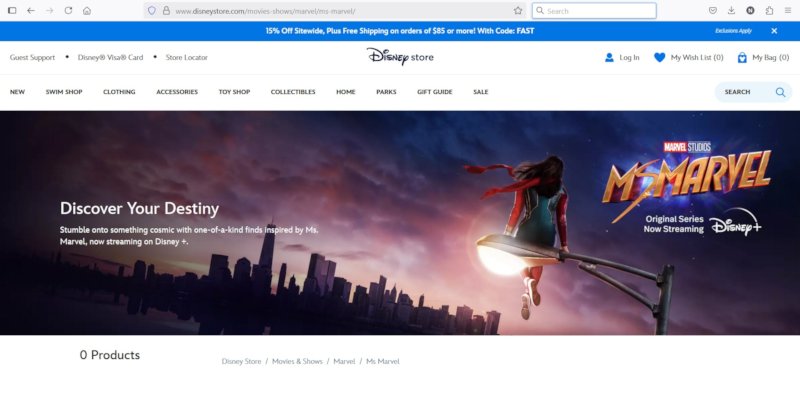
As a matter of fact, there is only one item on the entire DisneyStore website that connects to Ms. Marvel. It is the Lego version of The Hoopty from The Marvels, and it contains a Ms. Marvel figure.
While other websites, like Amazon, do sell a Ms. Marvel shirt and some toys, the fact that Ms. Marvel is pretty much nonexistent on Disney digital storefront is a sign of how little the company cares about her. In contrast, look at all the other Marvel characters that DisneyStore.com carries merchandise for.
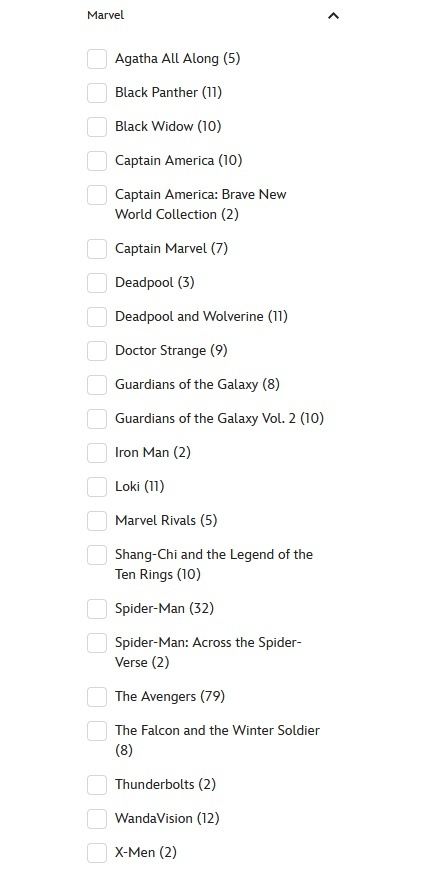
By contrast, the same search for “Spider-Verse” surfaces more than 40 SKUs—everything from Miles-branded lunchboxes to full Halloween costumes can be found. A contrast that illustrates how aggressively Disney backs characters it truly expects kids to adopt. Brick-and-mortar tells the same tale. Walk the Marvel aisle at Target or Walmart in mid-2025 and you’ll find end-caps devoted to Across the Spider-Verse, Deadpool & Wolverine, and even legacy Avengers reissues, but almost nothing featuring Kamala Khan. Without backpacks, birthday-party plates, or Halloween masks, the character never enters the everyday lives that turn children into lifetime fans.
Hasbro’s action-figure line underscores the half-hearted approach. The lone Marvel Legends “The Marvels” wave shipped just three movie figures—Carol, Monica and Kamala—while the remaining four slots and the Build-A-Figure went to unrelated comic characters. As io9 pointed out when reviewing these toys, “The Marvels is actually pretty light compared to some prior Hasbro waves tied into upcoming movies.” Now compare this to merchandise that has been created around Miles Morales, who has starred in two dedicated LEGO ranges, multiple Hasbro lines, and a licensed apparel blitz each time a Spider-Verse movie hit theaters.
Retail buyers take their cue from Disney and Hasbro; when those licensors offer only minimal SKUs, stores give the character minimal shelf space—or none at all. The result is a feedback loop where low visibility begets low demand, reinforcing the perception that Ms. Marvel is a niche property unworthy of mass-market real estate.
Why Miles Morales Succeeded Where Kamala Stumbled
Since Miles Morales swung onto the page in 2011, Marvel has protected his brand with consistent, top-tier stewardship. Co-creator Brian Michael Bendis kept Miles front-and-center in Ultimate Comics: Spider-Man, then shepherded him into the main Marvel universe without ever asking readers to abandon Peter Parker. Editorial treated Miles as a second flagship rather than a replacement, giving him uninterrupted monthly exposure, high-profile crossovers (Spider-Men, Champions), and marquee creative teams instead of stop-start miniseries. That stability built trust with retailers and fans alike. Additionally, each new story felt additive, not corrective. So when Sony looked for a fresh emotional core for its Spider-franchise, Miles arrived with a clear voice, a clean mythology, and no brand confusion.
Sony then stacked two flawless tent-poles under him. Insomniac’s Marvel’s Spider-Man: Miles Morales moved 6.5 million copies in its first eight months—an official figure Sony trumpeted alongside PS5’s own sales milestone. The Oscar-winning Spider-Verse films did even better: the 2023 sequel Across the Spider-Verse soared to $690.8 million worldwide on a mid-tier budget, more than triple The Marvels’ haul ($206,136,825) and the highest gross ever for Sony Pictures Animation. Retailers followed the momentum; “Spider-Verse” backpacks, Hasbro figures, and LEGO sets kept Spider-Man atop License Global’s seasonal “most-searched” toy lists, with Miles now sharing shelf space beside Peter Parker rather than fighting for it.
Kamala Khan had the opposite journey: a service-game flop, a box-office bomb, and merchandise so thin it rarely reached retail end-caps. Goodwill built by pioneering representation was washed out by headlines about write-downs and record-low premieres, leaving casual consumers to associate Ms. Marvel with commercial stumbles rather than breakout storytelling.
Conclusion: Time to Hit Pause — and Let Scarcity Do Its Work
A decade of stop-start publishing, shifting origin stories, threadbare merchandising, and three separate cross-media stumbles have stalled Kamala Khan short of household-name status. Even Disney now concedes that Marvel’s break-neck release cadence has strained resources, lowered content quality, and confused audiences, prompting executives to scale back output after 2023’s high-profile flops.
History shows the surest way Marvel resets a faltering brand is strategic absence:
- Wolverine stayed dead from Death of Wolverine (2014) until Return of Wolverine (2018) re-launched him as an event hero.
- Jean Grey spent thirteen years off the board before Phoenix Resurrection (2017-18) made her comeback a publishing centerpiece.
- Thor vanished after “Ragnarok” ended his book in 2004 and roared back with Straczynski’s 2007 relaunch, hailed as one of the medium’s landmark reboots.
- Fantastic Four went dark in 2015 and returned in 2018, with Entertainment Weekly framing it as Marvel’s First Family finally coming home after a multi-year absence.
Each pause rebuilt curiosity, allowed editorial to streamline continuity, and gave marketers a clean slate for a high-profile revival.
Ms. Marvel deserves the same luxury. Rather than pushing her into more half-formed initiatives, Marvel should shelve the character for a few years, limit her to guest spots, and wait until a creator with a singular vision—something on the level of Miller’s Daredevil or Coates’s Black Panther—can relaunch Kamala with a coherent origin, a definitive power set, and a full consumer-products plan.
Scarcity fueled demand for Wolverine, Jean, Thor, and the Fantastic Four; handled with equal discipline, it can give Kamala Khan the fresh start she needs to finally live up to her potential.
