


When The Bionic Woman emerged as its own series in 1976, it didn’t simply spin off from The Six Million Dollar Man. It quietly reworked what television believed a hero could be. Fifty years on, Jaime Sommers still lands with a soft but seismic thud. That endurance is all the more remarkable given that the idea of The Bionic Woman began not as a headline act, but as a narrative extension: a love interest for Steve Austin, conceived as his equal rather than a hero in her own right.
Television being what it was at the time, Jaime’s story initially ended in tragedy. After her debut in The Six Million Dollar Man, she was killed off in “The Bionic Woman (Part II)”, which aired in October 1975. Yet the character resonated far more strongly than expected. Jaime returned in “The Return of the Bionic Woman” in April 1976, an episode that functioned as a soft launch, signalling that the network was ready to explore her story beyond Steve Austin’s shadow.
That confidence paid off later that year. In July 1976, The Bionic Woman officially premiered with “Welcome Home, Jaime,” giving the character her own narrative space and marking the moment when Jaime Sommers truly became a television hero in her own right. From there, the series ran largely in tandem with The Six Million Dollar Man, sharing a universe while allowing Jaime to evolve into something rarer for the era: a lead defined not by conquest or domination, but by empathy, restraint, and moral clarity.
A different kind of power
Jaime Sommers, portrayed with quiet authority by Lindsay Wagner, was revolutionary not because she could run faster or hit harder, but because the series refused to hollow her out in order to make her formidable. She was strong and gentle. Capable and compassionate. The show understood that power need not come at the expense of humanity.
Crucially, Jaime was not written as “a woman acting like a man.” Her strength flowed from empathy, patience, and moral restraint. That distinction mattered. It allowed audiences to see heroism reframed rather than gender-swapped.
Representation that breathed
At a time when women on television were often treated as decorative or peripheral, with Police Woman starring Angie Dickinson standing as a notable exception, Jaime Sommers became the centre of gravity rather than an accessory. She made decisions, challenged authority, and questioned the motives of the OSI when necessary. Crucially, the series never framed her compassion as a weakness to be corrected.
Jaime’s emotional grounding came through her relationships, particularly with Steve Austin’s step-parents, who looked out for her after her own parents were killed in a car accident when she was just seventeen. This sense of found family anchored both the character and the series, giving Jaime a life beyond missions and bionics. She was a step-daughter, a friend, a schoolteacher, and a former professional tennis player. The bionics enhanced her body, but they never erased her identity.
Violence was never the point
One of the most defining choices The Bionic Woman made was to step away from the language of lethal force altogether. Jaime Sommers did not carry a gun. She did not rely on firearms, and she did not solve problems by killing her way out of them. Her strength was never framed as a licence to take life.
In fact, the only time Jaime is seen carrying a gun is in Jaime’s Shield, where she undergoes training at the police academy. Even then, the firearm is part of the setting rather than the solution. Outside of that single context, Jaime neither carries, uses, nor fires a gun across the series.
That absence is not accidental. It shapes the moral architecture of the show. Jaime’s heroism is built on intervention, protection, and restraint. She stops threats rather than annihilates them. In a genre dominated by escalation and firepower, The Bionic Woman quietly insisted that strength could exist without becoming violent, and that compassion was not a liability but a principle.
Episodes that still resonate
Doomsday Is Tomorrow (Parts I & II)
Doomsday Is Tomorrow remains, for me, the definitive Bionic Woman story and one of the series’ most enduring achievements. Even now, it feels unsettlingly prescient in the way it engages with ideas around automation, control, and artificial intelligence.
The episode centres on a well-meaning scientist who creates a doomsday device intended to enforce global peace. His logic is chillingly simple: if the cost of war is total annihilation, humanity will choose restraint. But when the scientist dies unexpectedly, his computer systems interpret his absence as failure and prematurely activate the device, beginning a countdown to the destruction of the world’s civilisations.
Jaime is sent in with a singular, stark objective: shut the system down by whatever means are available to her. What follows is not a battle of brute force, but a tense and thoughtful duel between Jaime’s bionics, her intuition, and an artificial intelligence programmed to protect its creator’s legacy at any cost. The story becomes a confrontation between human judgement and machine logic, asking whether intelligence without empathy can ever truly be trusted with moral authority.
Kill Oscar! (Parts I–III)
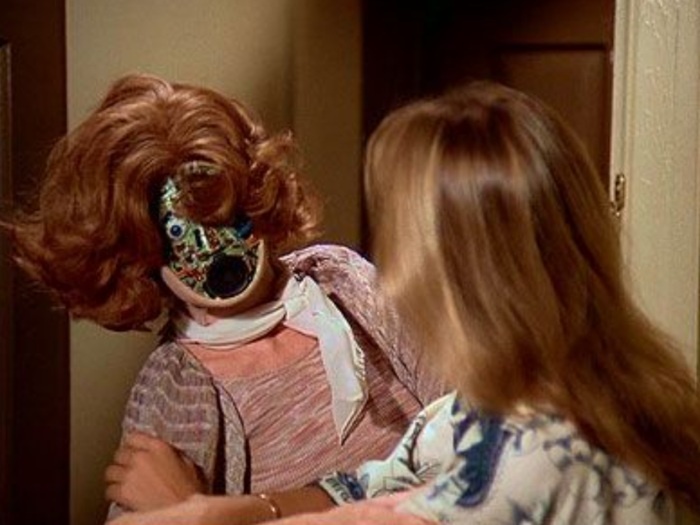
Kill Oscar! unfolds as a conspiracy aimed at the very heart of the OSI. The story centres on a plot to assassinate Oscar Goldman, orchestrated by embittered scientist Dr. Franklin, whose robotics programme was rejected in favour of the bionics initiative that emerged after Steve Austin’s accident.
Franklin kidnaps Oscar and replaces him with a robotic duplicate, while also planting a Fembot inside Oscar’s inner circle. This marks the first appearance of the Fembots and immediately establishes them as a new and uniquely dangerous kind of enemy.
What makes the Fembots so effective is not just their strength or deception, but their impact on Jaime herself. Elements of their design trigger a catastrophic feedback loop in her bionics, overwhelming the sensitivity of her bionic hearing and forcing her out of action. Steve Austin, immune to this flaw, dominates much of the second episode, a rare reversal that underscores Jaime’s vulnerability rather than diminishing her strength.
By the conclusion, Jaime recovers enough to re-enter the conflict, and the OSI is left facing a threat that technology alone cannot fully control. The Fembots proved popular enough to return multiple times in the series’ third and final season, but their introduction in Kill Oscar! remains their most unsettling appearance.
Bigfoot Crossovers
After the early crossovers with The Six Million Dollar Man helped establish Jaime Sommers as a lead in her own right, The Bionic Woman returned to shared-universe territory during its second season. The first of these was “The Return of Bigfoot: Part II,” which shifted familiar mythology firmly into Jaime’s orbit.
In the episode, Jaime is sent on a rescue mission to locate Steve Austin, who has once again become entangled with the mysterious alien observers monitoring Earth. In helping them, Steve has been exposed to lethal radiation poisoning. Knowing time is running out, he asks Jaime to track down the aliens and secure a dose of their miracle drug, Neotraxin, the only substance capable of saving his life.
The mission places Jaime directly in the path of the Bigfoot robot Steve previously battled. Rather than simply repeating past spectacle, the episode reframes the conflict through Jaime’s perspective, reinforcing her capability while expanding the franchise’s strange but compelling blend of science fiction, folklore, and Cold War paranoia.
Max, the Bionic Dog
The third-season premiere marked a period of transition for The Bionic Woman. “The Bionic Dog” coincided with the show’s move from ABC to NBC, a shift that brought noticeable budget cuts and limitations on visual effects and large-scale stunt work. What the series lost in spectacle, it often regained in intimacy.
Max is introduced as an OSI experiment that has been deemed a failure and scheduled for termination. Jaime refuses to accept that verdict. Rather than attempting to “fix” Max through force or recalibration, she succeeds by connecting with him emotionally, revealing that the project’s failure was never technical but relational. Max responds not to commands or protocols, but to trust and care.
By the end of the episode, Max’s life is spared, and while he appears only intermittently in later stories, his presence reinforces one of the show’s central ideas: technology alone is never enough. Without empathy, even the most advanced systems are incomplete.
A legacy that resisted reinvention
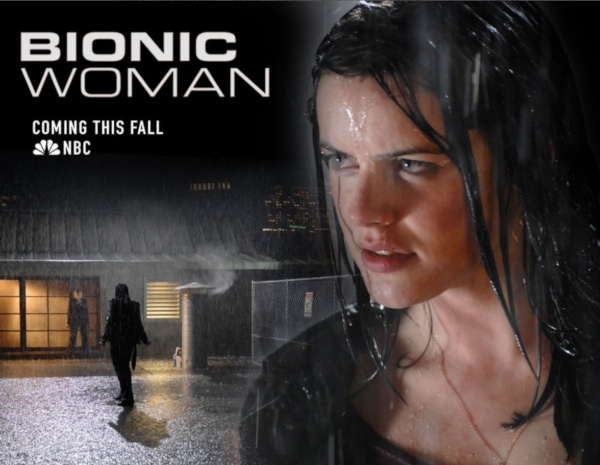
In 2007, NBC attempted to revive the property with a darker reimagining titled Bionic Woman, casting Michelle Ryan, fresh from EastEnders, as a new incarnation of Jaime Sommers. The series aimed for a more brutal, contemporary tone, leaning heavily into combat choreography and moral bleakness in an effort to modernise the premise.
The attempt, however, struggled to connect. Stripped of the empathy and restraint that had defined the original, the reboot failed to capture what made Jaime Sommers resonate in the first place. Original series star Lindsay Wagner was candid in her assessment, remarking:
“I saw it. It was a totally different show. It had nothing to do with anything we tried to do except the title and the fact she had strength.”
Despite an initially strong launch, the 2007 series faltered quickly. Only nine episodes were broadcast before NBC cancelled the show, bringing the latest attempt to return Jaime Sommers to television to an abrupt end. The failure served as an unintended affirmation of the original series’ philosophy: strength without compassion may look modern, but it rarely endures.
A legacy that still runs
For many viewers, The Bionic Woman was quietly formative. It told women they could be strong without becoming cold, independent without becoming isolated, and heroic without surrendering kindness. It also broadened how heroism itself could be understood.
Half a century on, Jaime Sommers remains a reminder that the most enduring strength isn’t found in how hard you hit, but in what you refuse to become.
Still running. Still listening. Still choosing empathy.

Brilliant article Ian. I wonder if Chloe Zhao will take any inspiration from The Bionic Woman when she brings Buffy back?