


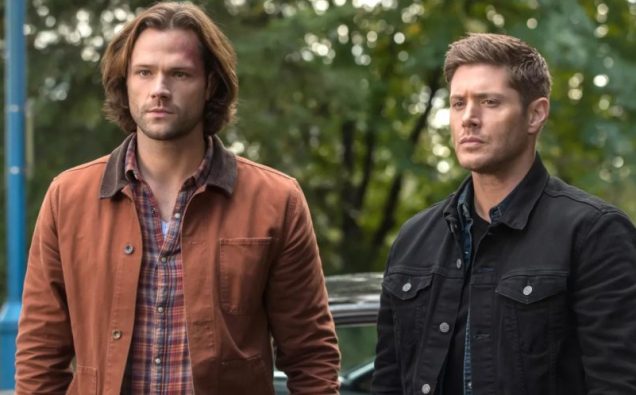
Supernatural premiered on September 13, 2005 and, across 15 seasons and 327 episodes, raided urban legends, global folklore, and scripture to build TV’s most eclectic monster manual—starting with wendigos and shapeshifters and scaling all the way up to Reapers, Horsemen, archangels, and primordial gods.
What began as salt-and-burn road horror evolved into a full cosmology with rules and tools—devil’s traps and angel blades, alphas and tulpas—while still delivering case-of-the-week chills.
Powered by Vancouver grit, classic-rock swagger, and an Impala trunk full of lore, these creatures didn’t just scare; they pushed the Winchesters’ story and the fandom’s language forward.
Two decades on, these are the creatures that defined the show’s scares, myth-arc, and vibe.
1) Angels & Archangels
When Castiel blew out the barn lights in “Lazarus Rising,” the series shifted from urban legends to a cosmic war.
Angels (and their big brothers, the archangels) became as dangerous as any demon—divine shock troops with their own agendas.
2) Demons
From Azazel to Lilith to Crowley, demons powered the show’s original engine: possession, exorcisms, and Faustian bargains.
Crossroads lore (and those red-eyed dealmakers) gave Supernatural its grinding tragedy.
3) Reapers (and Death)
Neutral psychopomps on paper, terrifying in practice—especially once the Pale Horseman himself rolled into Chicago to “O Death.”
Reapers and Death anchored the show’s rules about fate, souls, and the Natural Order.
4) The Darkness (Amara)
God’s twin and the embodiment of un-creation, Amara made season 11 feel apocalyptic in a new way—less prophecy, more primordial family drama.
5) The Empty
A void outside Creation where angels and demons sleep forever, ruled by a moody cosmic entity.
The Empty upped the metaphysics and gave the show a literal beyond-the-afterlife endpoint.
6) Leviathans
Ancient, hungry, corporate. Season 7’s black-goo body snatchers (led by Dick Roman) weren’t everyone’s favorite arc, but they’re unforgettable: nearly unkillable, organized, and ravenous.
7) Nephilim
By the end, a Nephilim—Jack—was central to everything. Half human, half archangel, totally game-changing for the show’s power scale and its found-family heart. (Supernatural Wiki)
8) Hellhounds
Invisible, unstoppable debt collectors that drag deal-makers to Hell. Their paw-print sound design and the way characters hear them before we do? Peak nightmare fuel. (Supernatural Wiki)
9) Vampires
Supernatural vamps aren’t garlic-averse sparkle fiends—they’re nest-building predators (with an Alpha) who recur across eras, from “Bloodlust” to later seasons. Decapitation > stakes. (Supernatural Wiki)
10) Wendigo
Early-season mission statement: take a campfire legend, make it hunt you in the dark woods, and sell the brother-banter with flares and fear. A template for the show’s best MOTWs. (Supernatural Wiki)
11) Eve (Mother of All)
A primordial creator of monsters who births “alphas” and nasty hybrids (“Jefferson Starships”). Brief but bold, she reframed monster ecology beyond simple lore entries. (Supernatural Wiki)
12) Shapeshifters
Skin-shedding, identity-stealing antagonists that let the show play doppelgänger paranoia and bank-heist mayhem (“Nightshifter” hive, rise). (Supernatural Wiki)
13) Djinn
No wishes—just dream-traps. The djinn’s touch strands victims inside blissful alternate lives while they’re slowly drained, giving us one of Dean’s defining hour-long what-ifs. (Supernatural Wiki)
14) Pagan Gods
From the Vanir scarecrow to the very dark “Christmas” couple, pagan deities let the series poke at suburban horror and old gods hiding in plain sight. (Supernatural Wiki)
15) Werewolves
Tragic turns and doomed romances (“Heart,” anyone?) made Supernatural’s lycanthropes more melancholy than monstrous—until they weren’t. (Supernatural Wiki)
16) The Four Horsemen of the Apocalypse
War in a cherry-red Mustang; Famine in a black town car; Pestilence with the sniffles; and Death with a scythe and a pizza craving. A perfect Kripke-era escalation. (Supernatural Wiki)
17) Siren
A single-episode standout that weaponized need—not just lust—to fracture partnerships and turn hunters on each other. (“Sex and Violence” still stings.) (Supernatural Wiki)
18) Ghouls
Corpse-eaters who can wear their last meal’s face. “Jump the Shark” used them for one of the show’s nastiest twists about family and identity. (Supernatural Wiki)
19) Shtriga
The childhood boogeyman that built Dean’s guilt complex—and one of season 1’s creepiest hunts—by preying on the defenseless. (Supernatural Wiki)
20) Tulpa
Thoughtforms made real by belief and repetition—Supernatural’s meta monster. “Hell House” proved that in this universe, stories don’t just matter; they kill.
