


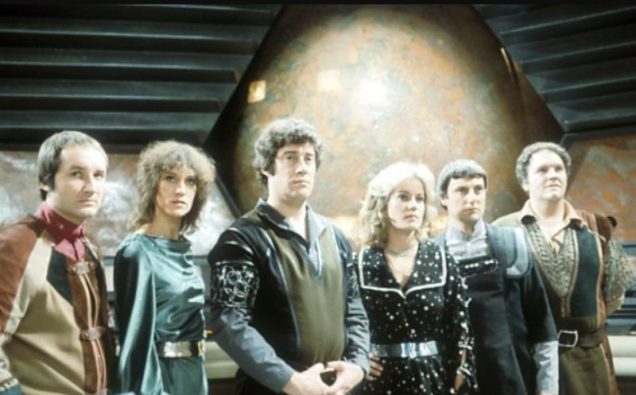
Last week it was announced that Peter Hoar and the newly formed Multitude Productions have secured the rights to reboot the classic British science-fiction series Blake’s 7.
With that in mind, we thought this was the perfect moment to set out a Top 10 list of what we’d like to see in a new iteration of the show, along with some of the creative choices we’d strongly prefer it avoided. Blake’s 7 remains one of the most politically charged, morally challenging science-fiction series the UK has ever produced, and any remake will live or die by how well it understands that legacy rather than simply borrowing its iconography.
1. Don’t gender-swap Blake or Avon.
Gender-swapping Blake or Avon would be the most predictable, least imaginative way to signal modernity.
The original Blake’s 7 never needed that approach. Its female protagonists and antagonists were already sharply written, intelligent, dangerous, and morally complex. In many cases, they were ahead of their time, not in spite of the era in which they were written, but because of the confidence behind them.
The answer for a remake isn’t revisionism. It’s expansion.
Write strong male characters. Write strong female characters. Introduce new characters who reflect a broader range of identities without rewriting the foundation. A trans character written as competent, integral, and unremarkable in their existence would be far more progressive than reshuffling legacy roles for symbolic reasons.
Good writing has always been Blake’s 7’s strongest weapon. It still is.
2. Don’t change the Liberator. Ever.
The Liberator is quietly iconic because it refuses almost every lazy science-fiction instinct.
It isn’t a battleship, a fighter, or a flying monument to aggression. It is smooth, symmetrical, alien, and ideologically neutral. No obvious front. No threatening silhouette. A ship that does not posture, yet is devastatingly powerful.
That restraint is exactly why it still works.
The Liberator’s influence can be felt in later science-fiction designs that favour elegance, intelligence, and otherness over brute force. Updating it should mean improved lighting, scale, and surface fidelity. Not redesign. The moment you touch the silhouette, you lose the metaphor.
The Liberator isn’t broken. It’s timeless.
3. Make Commander Travis scarier.
Commander Travis worked because he wasn’t theatrical. He was procedural, obsessive, and relentless.
His eye implant was primitive even by the standards of the late 1970s, but that crudity made it effective. It didn’t look like an upgrade. It looked punitive. A visible sign that the Federation did not heal its failures, it repurposed them.
Brian Croucher’s performance leaned into that cruelty of restraint. Travis didn’t rage. He fixated. Blake wasn’t simply a target, but an unresolved wound.
Any remake should resist the urge to “improve” him with flashier cybernetics or exaggerated brutality. Travis is frightening because he is being hollowed out by obsession, not empowered by it.
The shoes to fill here are enormous, not because of nostalgia, but because Travis represents something fundamental about authoritarian systems: how they grind people down and keep them useful.
4. Don’t rush to bring Servalan into the story.
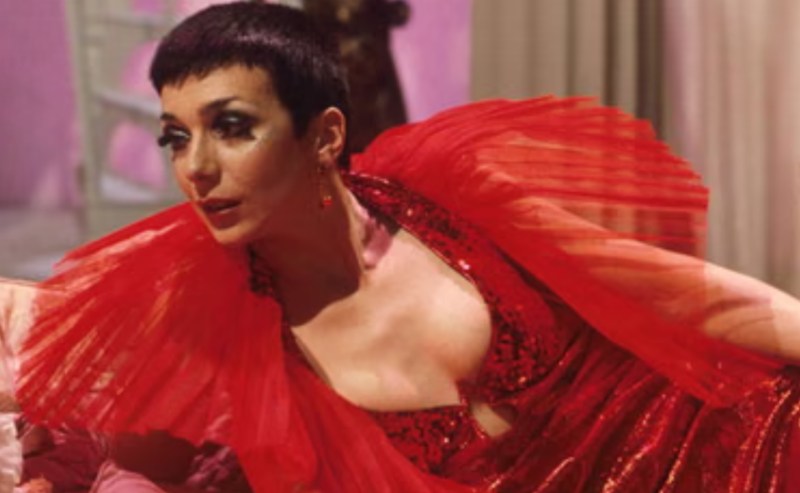
One of the smartest decisions in the original series was patience. Servalan did not arrive immediately, and when she did, she felt like an escalation rather than an addition.
With Travis actively hunting Blake and the crew, a first season already has momentum. Travis represents enforcement. Servalan represents authorship. The difference matters.
Saving Servalan for the finale of the first series would give her arrival genuine impact. Not a tease. Not a cameo. A statement.
Casting will be difficult. Jacqueline Pearce did not merely play Servalan, she defined her. Any attempt at imitation would be a mistake. The solution is confidence. Let a new Servalan arrive fully formed, commanding the narrative because the story has earned her presence.
Servalan should feel inevitable, not immediate.
5. Don’t soften the moral ambiguity.
Blake’s 7 never reassured its audience, and it should not start now.
The crew were not romantic heroes. They were compromised, divided, frequently wrong, and often dangerous to those around them. Innocent people died because of their decisions, and the series did not pause to excuse or soften that.
The Federation was unquestionably authoritarian, but the resistance was never morally pure. Blake’s certainty could be as destructive as Travis’s obedience. Avon’s pragmatism often slid into nihilism.
Modern television has a habit of sanding this edge down in the name of relatability. That would be fatal here.
Blake’s 7 was never about good people fighting evil. It was about what prolonged resistance does to people, and how easily conviction curdles into extremism.
6. Keep the real locations.
A major part of Blake’s 7’s identity came from its use of real locations across the UK.
Quarries, abandoned factories, industrial wastelands. These places were lightly dressed, not overwritten. The result was a retro-futurist universe that felt lived in, functional, and decaying.
Modern CGI environments can be impressive, but they often feel weightless. Too clean. Too controlled.
Blake’s 7 never felt safe. Its worlds felt worn down by authoritarianism and neglect. A remake should enhance reality where necessary, but never replace it. Dirt, weather, and decay do more world-building than any digital skyline.
7. Don’t shy away from the violence.
The original series was never coy about violence. It simply understood how to deploy it.
Torture, execution, coercion, and psychological abuse were often implied rather than dwelled upon, which made them more disturbing. Violence in Blake’s 7 was bureaucratic. Procedural. A tool of governance rather than spectacle.
A remake should not dilute this.
Violence should feel consequential and uncomfortable. Death should not be neat. Torture should not be stylised. The Federation must feel genuinely dangerous, not theatrically villainous.
Remove that edge, and the stakes collapse.
8. Treat the Federation as a system, not a single villain.
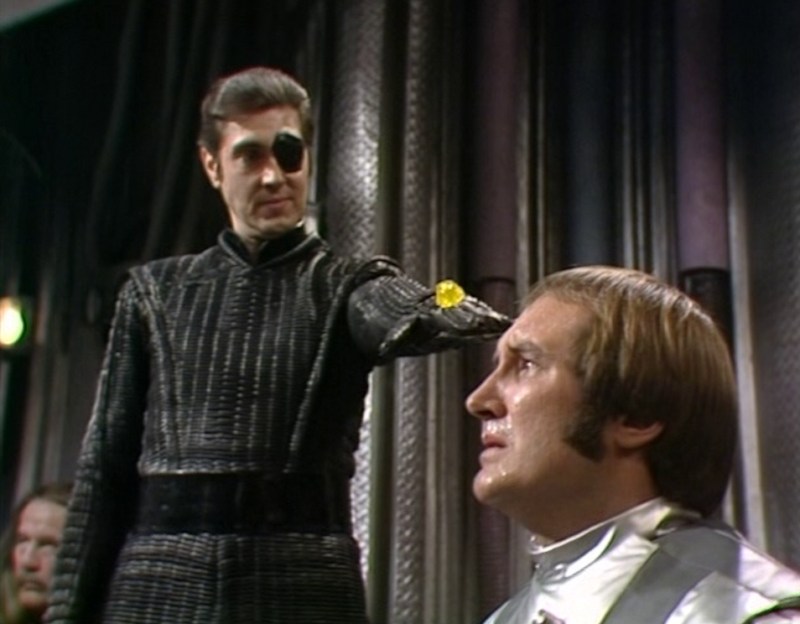
The true antagonist was never just Servalan or Travis. It was the Federation itself.
A remake should embrace this by occasionally shifting perspective. Not every episode needs to follow Blake and the Liberator crew. Show the machinery running. Show how normal authoritarianism looks from the inside.
An episode framed as Federation propaganda, perhaps a “day in the life” documentary following Travis, would be deeply unsettling. Sanitised narration. Selective editing. Violence reframed as public service.
Oppression doesn’t need monsters. It needs systems.
9. Modernise the Liberator’s interior without sanitising it.
While the exterior of the Liberator should remain untouched, the interior can be carefully modernised.
The ship should feel vast, alien, and occasionally uncomfortable. Advanced, but indifferent. Powerful, but not comforting. Retain signs of occupation, improvisation, and misuse by a crew that never fully understands what they are living inside.
Avoid turning it into a glossy showroom. The Liberator works best as a place people survive in, argue in, and slowly deteriorate in. Not a place they ever truly belong.
10. Show that AI isn’t the problem. How it’s used is.
Blake’s 7 was asking intelligent questions about artificial intelligence long before it became fashionable.
Zen and Orac were not villains. They were mirrors. Their dangers lay not in malice, but in misalignment, coercion, and human abdication of responsibility.
A remake should resist framing AI as inherently evil. Instead, it should show how systems reflect the ethics, priorities, and failures of those who control them. When harm occurs, it is almost always because humans have surrendered moral agency in exchange for efficiency or certainty.
Blake’s 7 never warned audiences about technology.
It warned them about power.
Final Thoughts
Blake’s 7 was created and first aired on UK television 48 years ago, and has enjoyed numerous repeat showings on UK Gold and other channels in the decades since. The series was loved for its unflinching portrayal of the social mores and flaws of human nature when a political system is in place that limits humanity, empathy, and compassion to the point where they are treated as luxuries, reserved only for the deserving.
It was a show that illustrated both the limitations and the perceived advantages of systems of control, while never losing sight of the human cost those systems impose. It is for those reasons, and many others, that Blake’s 7 still enjoys a loyal and engaged fan following to this day.
That loyalty also means any remake that fails to treat the material with respect is likely to alienate long-time fans. However, a thoughtful remake is achievable, and arguably necessary. In an era where political instability, authoritarian drift, and institutional distrust feel increasingly familiar, Blake’s 7’s core themes remain as relevant as ever.
Handled properly, a new iteration wouldn’t be revisiting the past.
It would be holding up a mirror to the present.
