


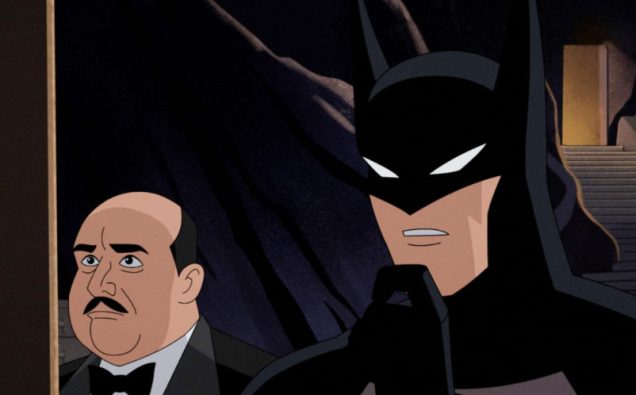
Synopsis: After a family tragedy, affluent philanthropist Bruce Wayne transforms into The Batman, where his crusade for justice spawns unforeseen ramifications.
The Stories
Picking up from where season one left off, Batman: Caped Crusader continues to deliver a more grounded version of the character and his villains while focusing on a season-long story arc. Set a few months after the events of season one, the series kicks off with the trial of crime boss Rupert Thorne, who finds himself under intense scrutiny from both the law and his former criminal associates. His former right-hand man, Edward Nygma, aka the Riddler, is keen to replace him as Gotham’s main crime boss, but a mysterious smiling figure is secretly manipulating events from the shadows.
Episode two sees Batman go up against a seriously ticked-off scientist who has been betrayed by Triad Industries. In the process of trying to stop her, Batman inadvertently helps expose the machinations of the company’s corrupt executives.
Episode three sees Bruce Wayne go undercover using the alias Matches Malone in order to protect a crook who can help him get close to Edward Nygma.
“The Spectral Hand” sees inmate Jim Corrigan volunteer for an experimental drug designed to extend life in the hope of finding redemption. This is the season’s festive episode and was one of my favourites of the series.
“Sudden Fear” sees the return of Harley Quinn, who aids Batman in exposing and capturing the Scarecrow, while “Her Dark Reflection” sees an innocent bystander with a split personality get close to Edward Nygma as a partner in crime in order to carry out her revenge plan.
“Zero Hour” sees Batman team up with kid detective Carrie Kelley as they take on this universe’s version of Dr. Freeze.
The series wraps up with “Dead Before Dawn” and “The Laughing Death,” in which the Joker announces himself to Gotham City by murdering a well-known TV personality and Gotham’s new mayor. However, these murders are merely part of a much wider scheme that threatens to send the citizens of Gotham descending into madness.
Voice Acting
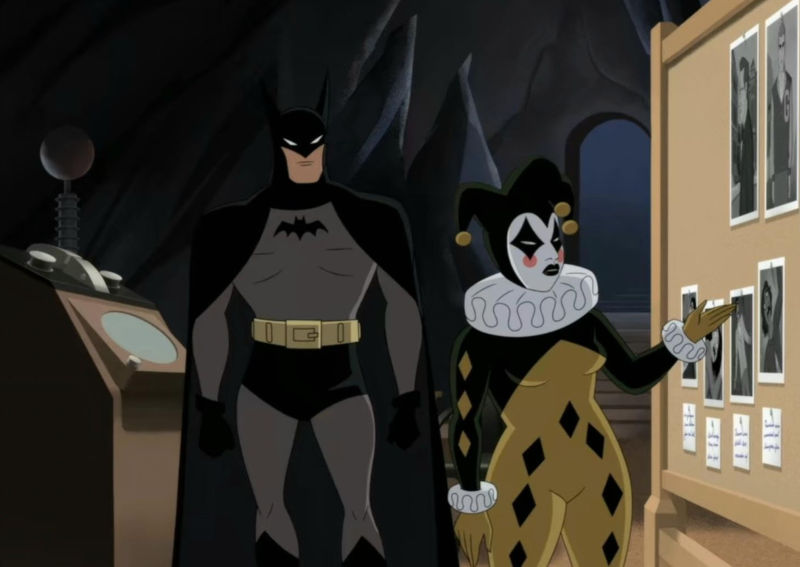
The voice acting throughout the series is fairly solid. Hamish Linklater remains steady as the stoic Batman, while supporting characters such as Michelle C. Bonilla’s Renee Montoya help keep this take on Gotham grounded and relatable. Montoya gets some particularly strong material this season and also finds some closure in her relationship with Dr. Harleen Quinzel, voiced by Jamie Chung.
Matthew Needham brings a much calmer and colder take on the Joker, portraying him more as a calculating master criminal than the manic agent of chaos that fans have become accustomed to. It’s certainly an interesting interpretation of the character, although I’m still somewhat on the fence about it.
Overall
This series continues to reimagine some of Batman’s most iconic villains and, as such, will likely continue to divide fans over what works and what doesn’t. Personally, I wasn’t particularly impressed with what was done with Edward Nygma, as much of his Riddler identity gets lost in the decision to turn him into a gang leader.
More interesting is what the series does with the Joker, although I’m still somewhat on the fence about this interpretation given that this season was really his introduction. I liked his brief cameos throughout the season, as they gradually built towards his eventual full reveal in the final two episodes. I also liked the fact that he is less manic than the Joker we have come to know and love, and I do wonder whether this colder and more calculating version might eventually evolve towards the more manic Joker we’re familiar with.
I also rather liked the introduction of Rose and Thorn, who is one of the more obscure characters from the DC universe. I felt that her origin was handled particularly well and hope we get to see her return in season three, should the show get picked up for another season.
- Stories8.0
- Voice Acting8.5
- Animation9.2
- Incidental Music9.5
