



Doug Wagner is a veteran comic book writer celebrated for his darkly comedic and horror-infused stories, especially his work with Image Comics on titles like Plastic, Vinyl, Plush, and the recent Plastic: Death & Dolls. His broader portfolio includes contributions to major franchises and publishers, with credits such as Marvel Zombies: Black, White & Blood, Klik Klik Boom, Beware the Eye of Odin, Batman: Arkham Origins, Legends of the Dark Knight, and World of Warcraft: Bloodsworn.
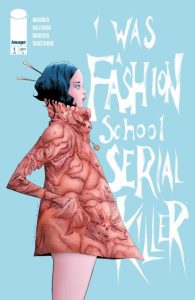
Over the past two decades, Wagner has written for a diverse range of companies including Marvel Comics, DC Comics, Image Comics, Blizzard Entertainment, Warner Bros. Pictures, Legendary Pictures, Summit Entertainment, TruTV, CBS, The CW Network, the NFL, Dynamite Entertainment, Top Cow Productions, and 12-Gauge Comics. His latest release from Image Comics, I Was a Fashion School Serial Killer, continues his tradition of genre-blending storytelling. Wanting to learn more about him and IWAFSSK, I was able to interview him for ScifiPulse.
To learn more about Wagner, you can find all of his socials and business pages here.
Nicholas Yanes: Growing up, what were some comic books you loved?
Doug Wagner: I started out pretty young. As a matter of fact, comics were instrumental in my learning to read. I’m not entirely sure I would have made it through school without them. I started reading comics around 5 years old. My first comics were books like Casper, Richie Rich, Hot Stuff, and Wendy the Good Little Witch. My favorite of that era was most definitely The Flintstones. I read that monthly for at least two or three years before graduating into superhero comics.
At that point, I’d pick up just about anything I could get my hands on, but I always favored Fantastic Four and the Avengers. Those were my go-to’s until I bumped in the Chris Claremont and John Byrne Uncanny X-men run. After that day, I was an X-men junkie for the majority of my teenage years. I didn’t even know comics shops existed until I was 16. That day changed my life. I discovered comics like the Badger, The Mark, Dark Horse Presents, and a plethora of indie comics.
Yanes: Are there any from your youth you still enjoy revisiting?
Wagner: Absolutely! I regularly re-visit Claremont’s X-men run, the entire run of Alien Legion, and a slew of indies – Hellboy, Body Bags, The Last American, and Sin City just to name a few.
Yanes: When did you know you wanted to become a professional creative? Was there a moment in which this goal crystallized for you?
Wagner: As fate would have it, I actually went to high school with Cully Hamner. We became friends during my senior year and started creating our own comics. After about six months of doing that, it finally dawned on me that there wasn’t anything else I’d rather do than write comic books. I remember that day like it was yesterday. I was 17. I woke up on a Saturday morning, and it hit me like a hammer – “I won’t to be a comic book writer for the rest of my life.”
I thought about it for about an hour as I ate breakfast, tracked down my mom, and told her. As you’d expect, she was terrified by the thought, but she told me to go for it… although, she did have to toss in a warning that it was going to be a hard, lonely, painful journey. She wasn’t wrong, but I wouldn’t change it for the world.
Yanes: You have worked for a wide variety of entertainment and comic book companies. What is your secret to surviving in such cut-throat industries?
Wagner: Resiliency. I wouldn’t say I’m exceptionally talented, and I am most definitely awkward socially and plagued by social anxiety. I think my biggest asset is I’m remarkably hard-headed. I’ve just kept at it over the years, learned to shrug off criticism, collected over 200 rejection letters, and weathered the storm until someone gave me a shot. I’ve probably done so beyond what most would consider rational.
Yanes: On this note, how do you think the entertainment industry in the US has changed during your career?
Wagner: Nick, I could write research papers on the differences since I started this quest. Just since the pandemic, we’ve seen massive changes in film, TV, and comics. I think probably the biggest change since I started is the ease of making your own comics without needing permission from a publisher. Anyone can create, print, and sell a comic today all by themselves. You can post your comic online, print it cheaply, sell it on Etsy, crowdfund it, all by yourself.
As a matter of fact, I tell every budding creator they should be doing so as quickly as possible. Want to get noticed by the likes of Marvel and DC? Make your own comic and prove to them you can create amazing content. Make it so its undeniable!
Yanes: Given that so many comic book, television, and film companies are losing customers (broadly speaking), what do you think that they should do differently?
Wagner: Let creators create. From what I’m seeing, too many companies are panicking, and this typically leads to execs and editors trying to hold on too tightly to controlling story. Some of the biggest breakthroughs over the years have always come from when creators are trusted to do what they do without constant interference. For the love of all that’s holy… let storytellers tell stories!
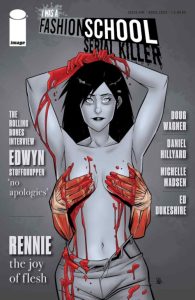
Yanes: Your latest story is I Was a Fashion School Serial Killer. What was the inspiration for this story?
Wagner: As with most inspiration, it came out of nowhere and completely by happenstance. When I was writing the epilogue for VINYL, I had to come up with something for Rennie. The muses whispered, “Wouldn’t it be funny if she went to fashion school?” Everything sparked from there. From that second, I was hooked. I had to know what happened.
Yanes: While developing this story, did you learn anything about fashion schools or the fashion industry that took you by surprise?
Wagner: I wouldn’t necessarily say surprised me, but during my research, I gained an even bigger appreciation for the craft. I knew it was a highly creative, competitive field, but I don’t think I knew how much so. All the creative fields are so difficult to make your way in. Fashion isn’t any different. It takes talent, fortitude, thick skin, and a determination that I don’t think can accurately be put into words.
You can graduate from even the most prestigious fashion schools in the world and still never get your foot in the door as a fashionista. I can’t tell you the respect I have for anyone that even attempts that journey.
Yanes: Every horror story tries to have a couple of unique kills. Are there a few kills in I Was a Fashion School Serial Killer that you are particularly proud of?
Wagner: Oh, yeah! I don’t want to spoil anything, but I’m particularly happy about what we do with Rennie’s necklace and with her weapon of choice for the finale. I still giggle maniacally when I re-read that final issue.
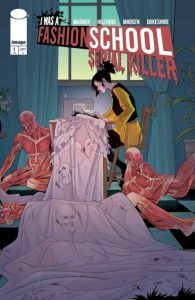
Yanes: As you developed Rennie Bethary’s character, was there a moment in which she came to life for you?
Wagner: I had a pretty good handle on Rennie from the start, but the moment I wrote the first lunchroom scene between her and Sofie, every aspect of who she is clicked into place. I knew who she was, who she wanted to be, and even though I knew she didn’t want a friend, a friend was the key to her transformation. An annoyingly optimistic, overly friendly fashionista that is as tenacious and unyielding as a certain serial killer.
Yanes: When people finish reading I Was a Fashion School Serial Killer what do you hope they take away from the experience?
Wagner: I write escapism, so my only hope is that for a few hours I give someone a break from the real world, from any troubles they may have in their life. If I’m lucky, they’ll have laughed, shed a tear, or been made to feel comfortable in their own skin, even if only for a moment. And at the end of it all, maybe know that there is someone else out there with as just a twisted sense of humor as them writing comics.
Remember, you can learn more about Wagner by finding all of his socials and business pages here.
And remember to follow Nicholas Yanes and ScifiPulse on X.
