


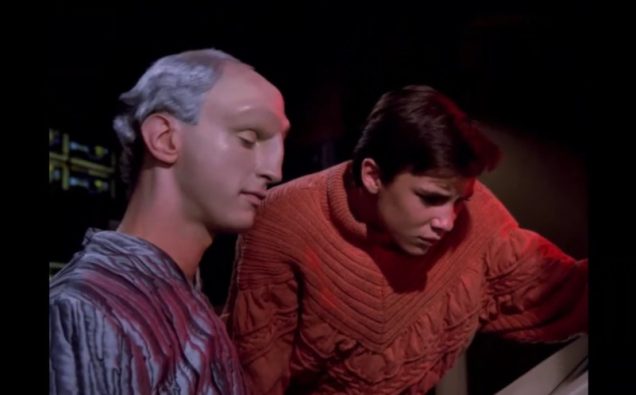
Since its release in 2006, Rhonda Byrne’s book The Secret sparked a huge online movement around manifestation and the law of attraction. However, Byrne herself acknowledges that her work was inspired by earlier self-help books, most notably Think and Grow Rich, first published in 1937. That book and others like it had already been exploring the idea that thoughts and beliefs can shape reality, decades before The Secret brought it into mainstream popular culture.
Manifestation Before The Secret

Authors like Napoleon Hill and thinkers such as Neville Goddard (who toured America in the 1950s teaching what he called the “Law of Assumption”) laid the groundwork for understanding how mental focus and intention could influence outcomes. These ideas predate the modern fascination with manifestation but are essentially the same principles: what you think, believe, and focus on has the power to shape your experiences.
It’s a fascinating concept, and one might assume that pop culture didn’t explore these ideas until the 2000s. Yet, long before The Secret, one of the most popular sci-fi series on television was experimenting with the exact same notion—through story, character, and imagination.
TNG’s Edge of the Universe
Just a couple of decades before Byrne’s book, Star Trek: The Next Generation aired an episode that effectively illustrated how manifestation works. That episode, Where No One Has Gone Before, comes from the show’s very first season, which premiered in 1987.
The story begins when the crew of the Enterprise-D invites an engineer aboard to make adjustments to the ship’s warp drive. This engineer, who is basically a pompous asshat, brings along an alien companion to help with the complex mathematics involved. But something goes wrong: the alien begins to phase in and out of existence, and the Enterprise-D finds itself trillions of light-years from its intended course, in unexplored space.
The alien, who calls himself The Traveler, ends up in sickbay, exhausted from the effort he exerted trying to help with the engineer’s theories—which, it turns out, are somewhat bogus. While in this remote region of space, the veil between thought, emotion, and reality becomes extraordinarily thin. As a result, the crew’s thoughts about what they desire or fear begin to manifest into reality.
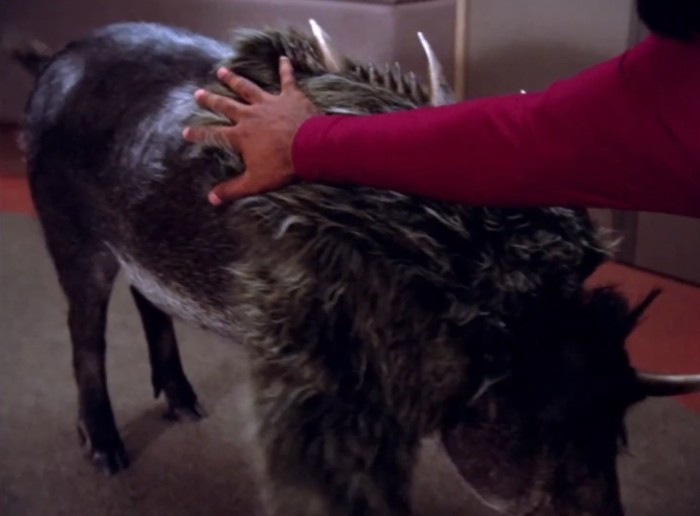
In one memorable scene, Worf absently thinks about his pet Targ—and suddenly, his Targ appears on the ship, visible to everyone, including Worf himself. At the same time, Tasha Yar thinks about her old cat and is unexpectedly transported back in time to her younger days, reliving the harrowing experience of fleeing a gang. Later, as Picard heads to engineering to figure out what is going on, he witnesses an Ensign performing ballet in the corridor. When he demands to know what she is doing, she instantly stops and is brought back to the present moment.
The episode demonstrates a profound idea: reality is not fixed but is influenced by the mind and emotion. By portraying these manifestations in a narrative, the episode makes abstract philosophical concepts tangible. It’s one thing to read about the law of attraction in a book; it’s another to see it dramatized with characters you care about, and to feel the emotional consequences of thought made real.
Manifestation and Quantum Physics
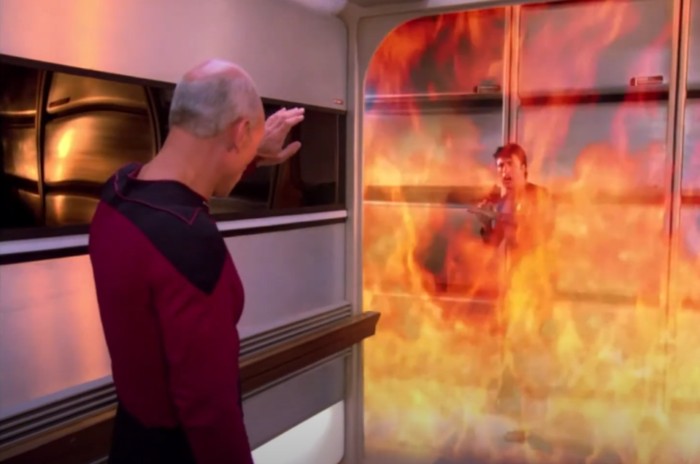
The connection to quantum physics is subtle but important. Many manifestation experts point to principles like the observer effect, which suggests that the act of observation can influence the behavior of particles at the quantum level. In simple terms, consciousness and attention aren’t passive—they can affect outcomes in measurable ways.
While Star Trek: The Next Generation doesn’t explicitly mention quantum physics in Where No One Has Gone Before, the episode dramatizes a similar idea. In the unexplored region of space, the crew’s thoughts, emotions, and intentions shape reality itself. The veil between mind and matter becomes so thin that imagination becomes action—a narrative illustration of what quantum physics hints at: that reality may not be as separate from consciousness as classical physics once assumed.
By presenting these ideas through story rather than theory, TNG allows viewers to “experience” the concept of conscious reality in a way that’s both entertaining and intellectually provocative. The Traveler essentially embodies this principle, demonstrating that awareness, focus, and intention are powerful forces that interact with the very fabric of existence.
The Traveler and the Philosophy of Consciousness
At the heart of this episode is The Traveler himself. Unlike most aliens in TNG, he isn’t defined by technology, aggression, or politics. He embodies a higher level of consciousness—one in which thought, intention, and understanding actively shape reality. The Traveler suggests that humans, even without full awareness, have the potential to influence the universe around them simply through the power of thought and imagination.
The episode frames this philosophy through contrast. While the engineer relies on logic, calculations, and rigid scientific formulas, The Traveler relies on intuition, awareness, and the ability to perceive the underlying forces of existence. The message is clear: mechanical, analytical approaches have limits. True understanding and transformation come when thought, emotion, and intention are aligned.
This theme resurfaces in the Season 7 episode Journey’s End, where The Traveler returns in a more narrative-driven context. Although Journey’s End focuses more on Picard’s personal decisions and moral dilemmas than on literal manifestations, The Traveler’s philosophy underpins the story. It’s the same principle: consciousness is creative, and our decisions, values, and understanding can have profound consequences not only for ourselves but also for those around us. In both episodes, The Traveler illustrates that the mind is an active, creative force—a precursor to what self-help literature would later describe as the law of attraction or manifestation.
What’s particularly compelling is that TNG presents these ideas through storytelling rather than direct instruction. The Traveler doesn’t give lectures or handbooks; he demonstrates. The audience witnesses the results of thought made real, experiences the emotional weight of manifested fears and desires, and is invited to reflect on their own potential. This approach is more emotionally resonant than any self-help manual could ever be, because it engages viewers on both a narrative and psychological level.
Star Trek has always been more than a show about distant planets and alien species. It’s a lens through which human potential, morality, and consciousness can be explored. Where No One Has Gone Before and Journey’s End challenge audiences to consider how our inner worlds—thoughts, hopes, and fears—shape the outer world. Science fiction becomes philosophy, self-help, and imaginative adventure all at once.
Decades before the mainstream fascination with the law of attraction, The Next Generation offered an imaginative exploration of a simple but profound truth: our minds are powerful, and the line between thought and reality may be far thinner than we assume. Watching these episodes today, one can’t help but marvel at how a show from 1987 not only entertained but also captured the essence of a concept that would later become a global phenomenon. Star Trek, as ever, was boldly going where no one had gone before—into the very fabric of reality itself.
