


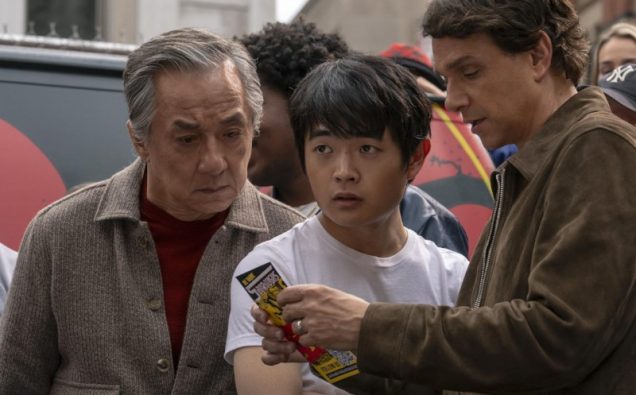
Synopsis: After kung fu prodigy Li Fong relocates to New York City, he attracts unwanted attention from a local karate champion and embarks on a journey to enter the ultimate karate competition with the help of Mr. Han and Daniel LaRusso.
The Story
Karate Kid: Legends sets its sights on bridging two generations of martial arts storytelling—the beloved 1984 original series and the 2010 reboot. On paper, this should be a heartfelt cultural crossover. In practice, it’s more of a narrative handshake than a hug. The story attempts to weave Miyagi-Do karate and Mr. Han’s kung fu into a shared legacy, with the tagline “Two branches, one tree” doing more thematic lifting than the script.
While the premise has potential, the actual execution feels shallow, relying heavily on nostalgia and broad-stroke exposition rather than nuance. There’s a missed opportunity to explore what these martial arts traditions truly mean, especially in contrast. Instead, we’re treated to a familiar underdog arc with occasional callbacks that seem more designed to spark Twitter nostalgia than serve the story.
Acting
Ben Wang brings fresh energy to the franchise as Li Fong, and he gives the material more weight than it arguably deserves. His grounded portrayal of a teenager trying to find his way in a chaotic world is one of the film’s stronger aspects. Jackie Chan and Ralph Macchio deliver the kind of performances you’d expect from two seasoned pros revisiting their iconic roles—but their appearances are sparing, and their emotional arcs barely skim the surface.
The supporting cast, which includes Joshua Jackson and Sadie Stanley, do their best with what they’re given—but “what they’re given” often feels like a plot device with dialogue. A brief cameo from a Cobra Kai fan-favorite is tossed in like a garnish, not a meaningful contribution.
Overall
There’s no shortage of flying fists and slow-motion kicks here, but the impact is hit-or-miss. Jackie Chan’s choreography is still sharp, and the film wisely leans into his flair for physical storytelling in its better sequences. However, the stunt work occasionally gives way to slick CGI embellishments that undercut the grounded appeal fans associate with Karate Kid.
The action often feels overproduced rather than visceral. It’s not Fast & Furious levels of physics-defying, but it also doesn’t channel the intimacy or grit that made earlier films so satisfying. You’ll be entertained, but not breathless.
Dominic Lewis handles the score with a competent, if uninspired, hand. The music does just enough to emotionally cue the audience—uplifting beats for training montages, soft strings for father-figure pep talks—but none of it is memorable. There are nods to past themes, but they’re more faint echoes than stirring reprises.
Much like the story, the soundtrack wants to balance legacy and freshness, but ends up sitting too safely in the middle.
Karate Kid: Legends plays like a franchise boardroom compromise—pleasing no one entirely, but not offending anyone enough to cause a scene. It has earnest performances, the odd satisfying fight scene, and enough legacy cameos to tease future streaming spin-offs. But it’s also a film that’s trying very hard to matter, while forgetting to be particularly fun or emotionally resonant. Nostalgia can only kick so far.

- Story6.5
- Acting7.0
- CGI & Stunts6.5
- Incidental Music5.0
