


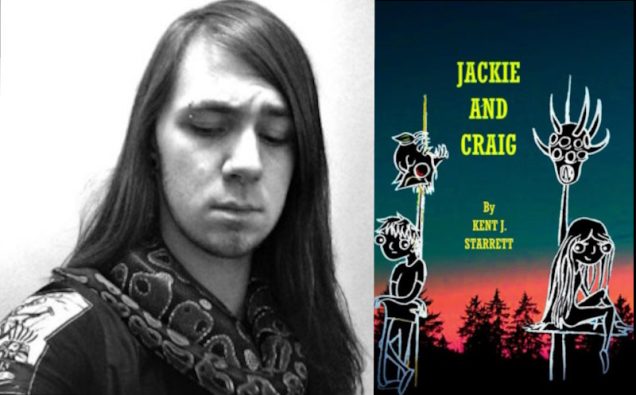
Scifipulse recently caught up with Kent J. Starrett. He is a 28-year-old author and artist who lives in Upstate New York. Kent is the author of the Teenage Wastelands Saga, which comprises the novels Jackie and Craig, The Rise and Fall of the Sky Valley Cult and Escape from Concordia. Kent’s other works include the dark comedy Lights are Off, but Everyone’s Home. As well as the picture book The Star Pixie and the Serpent Queen. Whilst interviewing Kent, I was able to find out about his upcoming books When Tomorrow Comes and Val, Otto and the Carnomancer Conspiracy. And also his thoughts on trigger warnings and the future of autistic representation in media.
SFP: What made you want to be a writer?
Kent J. Starrett: I’ll never forget the day I knew being a writer was the right choice.
I was in High School, and like most awkward, eccentric kids, I got harassed a lot. I’d written a short story called “The Backwater Roads,” which had come to me in a dream (and which you can find an reading of on my YouTube channel, Thoughtful Devil, read by yours truly!)
One day, on the school bus, a copy I’d printed up of Backwater Roads fell out of my backpack. A group of kids that’d been terrorizing me constantly got a hold of it, and started reading it aloud. At first it was just to make fun of me, but as they kept reading they all started getting hooked. Eventually they were all totally engrossed by it, and even though after that they all made jokes about me being a psychopath or a future school shooter, they respected me and said good things about that story. From then on there I knew I had to pursue this, and horror has been one of my greatest loves ever since (and, professionally, it’s been very good to me).
SFP: Do you think that there are some situations where fiction should be a safe space? Or should it always shine a light on what its audience is afraid to acknowledge?
Kent J. Starrett: Sometimes, fiction ought to be a safe place for people. But it needs to be advertised as such beforehand, so people clearly know what they’re getting into. My most popular book in both sales and fandom has been a picture book about positive self-image called “The Star Pixie and the Serpent Queen.” That book is one that lots of people have cried over, and I actually met somebody who had a quote from the book tattooed on them (“Everyone’s hideous, not just you and me/they’re ugly in ways they pretend not to see!”). So Star Pixie is essentially a safe space for people to let out their traumas and emotions, and I’m always grateful for that.
The Teenage Wastelands series (Jackie and Craig, Sky Valley and Escape from Concordia) is a different story. Those books are nominally for teenagers but they take place in a nightmarish world, full of constant trauma, pain, death, abuse, and existential horror. I’ve had some people who’ve been abused or lost their loved ones tell me they see so much of their struggles in those books. But some irate parents have sent me hate mail about how I shouldn’t be depicting teenagers going through that, or how they think I exploit real-world tragedies and struggles.
Ultimately, I think if some fiction is to be a safe space, it has to be clearly advertised as such. Bluey isn’t shown on Shudder and The Descent isn’t on Disney Plus, after all.
SFP: Which writers are you inspired by?
Kent J. Starrett: I was always inspired by very strange writers who break the mold and play with ideas in unconventional ways. My favorite book is “The Hellbound Heart” by Clive Barker, and another one is “John Dies at the End” by Jason Pargin. Barry Lyga was a favorite author of mine as well, as he didn’t talk down to his readers.
I read everything growing up, from Bridge to Terabithia to Lovecraft and Ligotti (which is probably how “Jackie and Craig” came to be, haha). It’s amazing what you can do with words just be choosing or rearranging them, whether it’s totally barren, shell shocked prose like Cormac McCarthy‘s or very indulgent, beautiful prose like Tanith Lee‘s.
SFP: What do you think the future of neurodivergent representation in fiction looks like?
Kent J. Starrett: I’m hoping as we go forward, the phrase ‘Nothing about us, without us’ is taken more into effect. Historically a great deal of autistic representation is via the conduit of Neurotypical people, whether that’s Rain Man or Atypical. Media that actively involved autistic creators always feels more authentic, whether that’s Mary and Max (a film I recommend to everyone) or more recent projects like Austin, a recent television show starring Michael Theo of Love on the Spectrum.
I also hope, as time goes on, that we see a wider variety of Autistic characters. It’s true I do have a whimsical, childlike side, but Popular Culture’s stock autistic person is either a perpetual manchild or a soulless robot.
One aspect of my personal autistic experience that I tried to bring to Teenage Wastelands (as well as an upcoming book) is cynicism. You learn very quickly that many people are receptive and manipulative, and it led to me being very guarded and defensive when I was younger. It’s an aspect I put into the autistic character in TW, Amy Black. And if I had known how popular she would have been, I’d have made her the protagonist. But hey: you live, you learn.
SFP: Is there going to be a sequel to your book Escape From Concordia?
Kent J. Starrett: Escape from Concordia was the third book in the series, so I always tell everyone to start with Jackie and Craig. I planned three books originally, but what was book two got split into books two and three. I’ll probably return to that world eventually, but those books took up seven years of my life. I’ve loved the lore, building the world, watching it grow like a tree (I was only 22 when J&C was new!) but complications of the Pandemic stretched out the releases by years, and I’m both too overwhelmed with how vast the world and characters grew and too eager to do something different to go back for a while. For now, EFC is the end of the series. And, fortunately, it ends on a good enough note that if I get hit by a car the series has a satisfying, bittersweet ending.
SFP: Following on from that question, what are you working on at the moment?
Kent J. Starrett: I have a new picture book coming out this year! My editor is always hounding me about doing more of them, since Star Pixie is by far my greatest success as an author. Hopefully “When Tomorrow Comes” will be here by October of this year, just in time for everyone’s favorite season. After that, I have a new book – which may potentially go to series, depending on how well it does – in the works, which features most of my strengths as an author. Building on what happened with Amy in TW, the new book features an autistic girl named Val and her best friend, the pale-as-death deep-south redneck Otto, as they try to navigate an infestation of supernatural monsters. It’s far more comedic than TW ever was, fully illustrated, and straight-up bizarre in so many ways. And merciful God, it’s gonna be shorter than any of the TW books.
Tentatively it’s titled “Val, Otto, and the Carnomancer Conspiracy.” Hopefully it’s out within a year of this interview, but we’ll see.
SFP: Do you have any advice for aspiring writers?
Kent J. Starrett: My best advice for aspiring writers: find beta readers, pay them if you can. And if you can hire a freelance editor, for the love of God, DO SO. Nobody will be able to give you better input than somebody else, and after rereading my own manuscripts – sometimes for days on end – I can tell you it saves you a huge headache in just having somebody else do it for you, even if you have to give up some Bills, Pounds or Euros to do so.
Also: promote. Ruthlessly, relentless, constantly promote. I do signings at all kinds of venues – artisan’s fairs, paranormal conventions, Pagan Festivals – anywhere where you can book a table, do it and try to sell. If you can print up merch to go with your books, do that as well! People may not like to read, but I’ve sold a fair number of T-Shirts with my designs and characters on them, and in some cases it’s even led to sales! I worked in customer service, so I have an advantage there, but remember you’re not just selling a product – you’re selling yourself. If people like you, and relate to you, they’ll care more about what you create. I have a fan, also on the spectrum, who came to every signing or event I ever had. She just liked talking to another autistic person, and related very heavily to Amy. Not only will going through the hard work of learning social skills and presenting yourself help your career, it’ll also make you friends. It’s exhausting as an autistic person to do this, but trust me, it is so very rewarding.
And, last but not least: figure out your market and sell to them. My market is primarily teenagers and adults who like quirky, Burtonesque art and worlds, so I’ve adjusted my career accordingly. I would love to write more non-genre works, like my autobiographical novel “Lights are Off, but Everyone’s Home,” but my market’s not ready for that…..yet.
SFP: Finally, what are your top 5 SF novels and why?
Kent J. Starrett: My top SF novels are as follows:
A Martian Odyssey, by Stanley Weinbaum – heavily dated and with some unfortunate remarks, but easily the greatest alien world ever imagined.
Dune, of course – you can’t ignore it, even when you try.
John Dies At The End – experimental, bizarre, hilarious and unmatched except, perhaps, by Hitchhiker’s Guide.
Lilith’s Brood, by Octavia Butler – I will never forget the descriptions in that book, when I was reading it late on a school night in my Junior year.
And A Scanner Darkly, by Philip K. Dick. I revisit that book every year and even I can’t be sure I didn’t just hallucinate it all, which is the ultimate compliment for a book about psychedelics.
Scifipulse would like to extend our most heartfelt thanks and warmest best wishes to Kent J. Starrett for so graciously taking the time to answer our questions.
Kent’s YouTube: Thoughtful Devil – YouTube
His Tumblr: @kentjstarrettofficial on Tumblr
Kent’s Twitter: Kent J. Starrett (@GaryOfJikunga) / X
Check out our Ada Hoffmann interview here
Check out our Yoon Ha Lee interview here
