


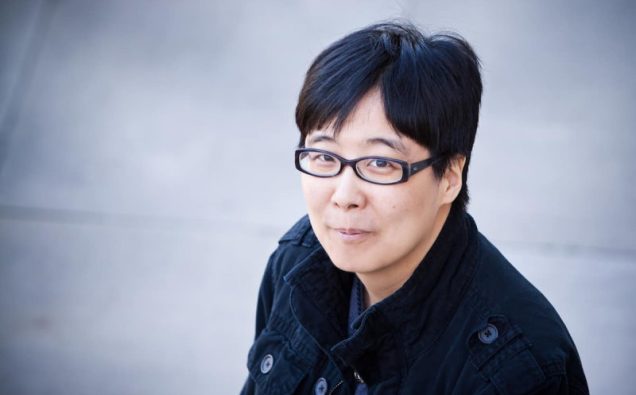
Scifipulse recently caught up with Yoon Ha Lee. He is a Korean-American sci-fi and fantasy writer. Who received a B.A. in math from Cornell University and an M.A. in math education. From Stanford University. Yoon’s first novel, Ninefox Gambit, won the Locus award for best first novel. And was a finalist for the Hugo, Nebula and Clarke awards. Its sequels, Raven Stratagem and Revenant Gun, were also Hugo finalists. Yoon’s hobbies include composing music, art and destroying the reader. He finds it a source of continual delight that math can be mined for story ideas. During this interview Yoon talks about the future of LGBTQIA+ and neurodivergent representation, advice for aspiring writers and changes in the publishing industry.
SFP: What made you want to be a writer?
Yoon Ha Lee: In 3rd grade, my teacher Mr. McCracken dressed up in a costume once a week to become Story Man. He read to the class, and this was at a point in my life where I assumed, vaguely, that at night the ceiling opened up and books floated down from the sky. It was very surprising to learn that books were written by people! Having learned that, I decided that I wanted to write books too. My early efforts were terrible and my first submission (in 5th grade) was justly rejected, but I can say that it was, at least, in standard submission format!
SFP: How do you approach worldbuilding in your novels?
Yoon Ha Lee: I’ve always liked the Michael Moorcock quote (I believe): “I only invent what’s necessary to explain the mood of a character. I haven’t thought about an imaginary world’s social security system; I don’t know the gross national product of Melnibone. If worldbuilding is a sophisticated working-out of how a world interacts in and of itself, I don’t really have any of that.”
I don’t think a simulationist approach to worldbuilding is wrong or bad, but I think it’s a stylistic choice rather than a necessity. Listen, I play the nitpicking game as much as the next reader, but if you’re kvetching about how the Slough of Despond in Bunyan‘s The Pilgrim’s Progress doesn’t granularly reflect the composition of swamp soil, you’ve missed the forest for the trees.
Especially when I’m writing sf/f, I ask myself, as though I were writing a proof in math (I got my B.A. in math): what is the point I’m trying to make? What is the key metaphor of the story? How can I build the world to support that metaphor?
More generally, I ask myself: what is the effect I’m trying to create, and what is the best tool, on average, to achieve that effect? For worldbuilding, maybe that’s exhaustive historically accurate simulationism or mimesis. Maybe it’s OuLiPo pastiche or absurdism. Maybe it’s videogame vibes. It’s different from story to story.
SFP: What writers are you inspired by?
Yoon Ha Lee: Lloyd Alexander for his lean elegance of prose and deadpan irony (The Kestrel).
Roger Zelazny (Chronicles of Amber, Creatures of Light and Darkness), Meredith Pierce (A Gathering of Gargoyles), and Patricia McKillip (A Song for the Basilisk) taught me that prose could be beautiful as well as functional.
But many of the writers who inspire me aren’t in prose fiction at all, or are fiction-adjacent: the team that wrote/designed/pitched the CRPG Planescape: Torment (you can find the pitch here: https://rpgwatch.com/files/Files/00-0208/Torment_Vision_Statement_1997.pdf), Liam Liwanag Burke‘s brilliant and brutal TTRPG Dog Eat Dog, interactive fiction (Andrew Plotkin‘s Shade, Emily Short‘s Pytho’s Mask or Galatea, Dan Schmidt‘s For a Change), John McPhee‘s essay “The Search for Marvin Gardens,” Charles Hampden-Turner‘s Maps of the Mind, mathematical writings by Douglas Hofstadter or Ivars Peterson or Theoni Pappas, the poetry of Sonya Taaffe or Amal El-Mohtar or Hussain Ahmed.
SFP: Have you got any advice for aspiring writers?
Yoon Ha Lee: The parts you can control are persistence, learning the craft, and not being a jerk or horrible person. This is an infuriating profession in that there is often a large element of luck and/or being in the right place at the right time; that said, fortune (as they say) favors the prepared.
In terms of the craft: I’ve talked to a lot of professional writers who all have wildly disparate processes. Writing how-to books or instructional material can be helpful, but always remember: if it doesn’t work for you, it may just be that it’s a process that your brain doesn’t like, and that’s okay. Pretty much the only non-negotiable is that at some point, words have to be produced in a format someone can read. Everything else? Have fun.
Clarity about your goals is important, and it’s worth reassessing those goals from time to time, because we change and the world changes. Are you looking to do this full time as a job? Do you want to write fanfic or fiction to share with your friends? Are you trying to get a message out or raise awareness about XYZ? Do you want people to love your characters? These are all good and valid goals, but they often require different approaches.
Finally, if you’re pursuing writing as a career, for money, research what’s involved, research the business end, and go in with your eyes open.
SFP: What do you think could be done in SF that has not been done yet?
Yoon Ha Lee: Most of my ideas here are things that haven’t been done for the good reason that they’re terrible.
SFP: What do you think the future of LGBTQIA+ and neurodivergent representation in SF looks like?
Yoon Ha Lee: Personally, my hope is that it becomes common and completely unremarkable. I may have been the only reader who didn’t notice the pronoun thing in Ann Leckie‘s Ancillary Justice unless people told me about it. (My first language, Korean, straight-up doesn’t have third person pronouns. This has not notably solved sexism in Korean culture.) I usually pick up a book based on “it has bunches of space explosions and EVERYONE DIES!!!” or “the author spends an entire chapter on exposition of Fuchsian differential equations with a digression into the dueling records of mathematicians, EN GARDE!!!” or “someone told me that there is an UNHINGED dubcon pairing and an amnesiac protagonist, YES!!!” rather than the factors above, but I want the representation to exist.
SFP: How has the publishing industry changed since you first started out?
Yoon Ha Lee: My first submission was in the early 1990s and I typed it on a typewriter and sent it in with a SASE. You have no idea how grateful I am that I can email submissions instead of running around begging any teachers, back in South Korea, to buy me US postage for the SASEs. (I have never seen an international reply coupon and am starting to think they are mythical, like Bigfoot and Zip drives.) Ebooks are a thing now; with my terrible eyesight, I appreciate the ability to change the font size! I have friends making a full-time living as self-published authors. Not all change is good for all people, but that’s always been the case.
SFP: And finally, what are your top 5 SF books and why?
Yoon Ha Lee: Anne McCaffrey‘s Dragonflight, which I read in 4th grade, was my real introduction to science fiction in prose format, and I still remember how the time travel in the plot broke my head open. Also I loved Lessa! Lessa/F’lar was probably my first ship.
Lloyd Alexander‘s The Kestrel was the first of his books that I encountered, also in elementary school, and remains my favorite war novel.
C. J. Cherryh‘s Cyteen with its claustrophobic depiction of social experiments, abuses of power, terribad parenting, and the nature of identity rewired my brain in college.
Douglas Hill‘s Galactic Warlord, which I discovered in high school, was what hooked me on space opera. I still get chills thinking of its opening: a dying man, the last of a society of honorable mercenaries, seeks revenge on the stranger who destroyed his world. Also lax starport security in a book written before 9/11.
And last but absolutely not least, Helen Keeble (as Zoe Chant)’s Firefighter Dragon, paranormal shifter romance. This is one of my great comfort reads, with a sizzling romance and some really interesting takes on worldbuilding mythic shifters!
Scifipulse would like to extend our most heartfelt thanks and warmest best wishes to Yoon Ha Lee for so graciously taking the time to answer our questions.
Yoon’s website: Yoon Ha Lee | author of science fiction & fantasy
His Bluesky: Yoon Ha Lee (@deuceofgears.bsky.social) — Bluesky
Yoon’s Twitter: deuceofgears (@deuceofgears) / X
Check out our Kalynn Bayron interview here
Check out our Lauren Melissa interview here
